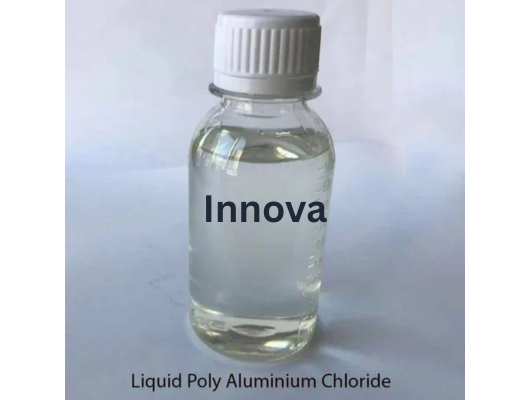
PAC Liquid 1350 — High-Alumina Polyaluminium Chloride for ETP and Wastewater
Innova Corporate (India) supplies PAC Liquid 1350, a high-alumina polyaluminium chloride coagulant for effluent treatment, sewage treatment, and industrial wastewater clarification. PAC is a pre-polymerised inorganic polymer. It works by neutralising the negative charge on suspended particles and bridging them into dense flocs that settle rapidly under gravity. Compared to traditional coagulants such as alum or ferric chloride, PAC typically forms flocs faster, works across a wider pH range, and produces less sludge. PAC Liquid 1350 is supplied as a ready-to-dose liquid with an alumina content of 13.50% ± 0.30.
Key characteristics of PAC Liquid 1350:
- High alumina content — 13.50% ± 0.30, giving more active coagulant per tonne of product compared to lower grades.
- Rapid floc formation and faster sedimentation compared to traditional coagulants.
- Effective across a wide pH range (typically 5–9).
- Lower dosage requirement compared to alum or ferric salts, reducing chemical consumption.
- Reduced sludge generation and improved dewatering.
- Non-foaming and easy to handle in liquid form.
- Stable under normal storage conditions.
Where PAC Liquid 1350 is used
PAC is a versatile coagulant used across water treatment applications:
- Effluent treatment plants (ETPs) — clarification of industrial effluents from textile, dye, food, tannery, and paper industries.
- Sewage treatment plants (STPs) — suspended solids and turbidity removal.
- Drinking water treatment — coagulation of suspended solids, organics, algae, and turbidity removal.
- Paper and pulp — retention, drainage, and sizing improvement in papermaking.
- Oil and gas, mining, metallurgy — clarification and solid-liquid separation processes.
How PAC works
PAC neutralises the negative charges on suspended particles and colloids in water. This allows the particles to collide and stick together, forming larger aggregates called flocs. PAC also works through adsorption bridging, where polymer chains bind particles together. The resulting flocs are dense and settle rapidly, making PAC effective for both high-turbidity water and industrial effluents with colour and suspended solids.
In a published jar test study on denim washing effluent, PAC combined with an anionic polymer achieved COD removal of 88.2%, BOD removal of 84.5%, TSS removal of 93.5%, turbidity removal of 96.1%, and colour removal of 93.5% at 60 mg/L PAC and 2.0 mg/L polymer at pH 7.2. The study concluded that coagulation-flocculation with PAC is a feasible primary treatment step for this type of effluent.
Dosing and jar testing
The optimum PAC dose depends on the specific water or effluent — turbidity, alkalinity, colour, TSS, and pH all affect coagulation performance. There is no universal dose. Run a jar test on the actual stream before full-scale dosing. A standard procedure — rapid mix, slow mix, settling, then measure turbidity/colour/COD — will establish the correct dose.
Innova can share a standard jar-test protocol and help interpret the results. Our technical support is remote and documentation-based.
Specification (typical values, PAC Liquid 1350)
| Parameter | Typical value |
|---|---|
| Appearance | Clear to slightly hazy liquid, pale yellow |
| Al₂O₃ content | 13.50% ± 0.30 (Innova grade specification; confirm on COA) |
| Basicity | 25–35% (typical for PAC 14 grade) |
| pH (5% solution) | 3.0–4.5 |
| Specific gravity (20°C) | 1.30–1.36 |
| Chloride (Cl) | 15–21% |
Note: Values above are typical for PAC 14 grades in the market. The Al₂O₃ value is Innova's grade specification for PAC Liquid 1350 and should be confirmed against the batch COA. COA and TDS are available on request.
Supply and packing
PAC Liquid 1350 is supplied from our plant at Dahej, Gujarat. Standard packing: HDPE drums and IBC totes. For bulk requirements, share your monthly quantity and delivery location so we can confirm logistics.
Technical support
Innova provides remote, documentation-based technical support: product datasheet, COA, safe handling guidelines, and jar-test protocol recommendations. We do not claim a local office or on-site presence.
FAQs
Q: What is the Al₂O₃ content of PAC Liquid 1350?
PAC Liquid 1350 has an alumina content of 13.50% ± 0.30. This is Innova's grade specification and should be confirmed against the batch COA. Typical PAC 14 grades in the market have Al₂O₃ in the range of 13.5–14.5%.
Q: What is the difference between PAC 1350 and PAC 1050?
The numbers refer to alumina content. PAC 1050 has approximately 10.50% Al₂O₃, while PAC 1350 has approximately 13.50% Al₂O₃. Higher alumina content generally means more active coagulant per tonne of product. The choice depends on your effluent load and should be confirmed by jar test.
Q: Can PAC Liquid 1350 be used for drinking water treatment?
PAC is used in drinking water treatment for turbidity and suspended solids removal. If you need a drinking water grade, confirm the certification status and suitability with us before ordering.
Q: Why is jar testing necessary?
Because every water and effluent stream is different. Turbidity, alkalinity, colour, and TSS vary from plant to plant and season to season. The optimum dose can only be found by testing your actual stream. Innova can share a standard protocol.
Q: Is COA and TDS available?
Yes. A Certificate of Analysis and product TDS are available for each batch. Request them when you enquire.
Q: What packing options are available?
Standard packing: HDPE drums and IBC totes. Share your quantity and location for a quote and transit estimate.
Enquiry
For pricing, COA, TDS, or a jar-test protocol, call +91-9312871070 or use the enquiry form. Share your application (ETP/STP/textile/paper) and approximate monthly quantity for a faster response.
Related products