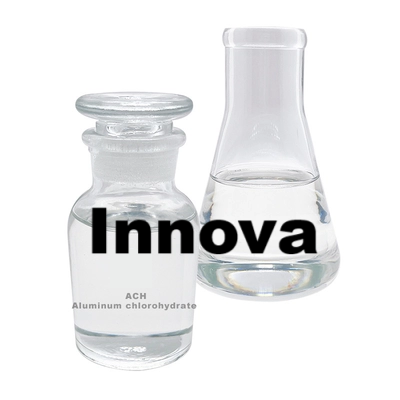
Aluminium Chlorohydrate Liquid 50% (ACH-I300) — Industrial Water Treatment Grade
Innova Corporate (India) supplies Aluminium Chlorohydrate (ACH) Liquid 50% Solution, grade ACH-I300, for industrial water and wastewater treatment across India. ACH is a highly polymerized aluminium-based coagulant with the general formula Al₂(OH)ₙCl₆₋ₙ, where n typically ranges from 3 to 5 for the highly polymerized species used in water treatment. Its high basicity and pre-formed polynuclear aluminium species give it distinct advantages over conventional alum and PAC in several Indian industrial applications: lower dosage requirements, reduced sludge volume, and lower residual aluminium in treated water.
Key performance characteristics of ACH-I300:
- High basicity (>82%) reduces or eliminates the need for pH adjustment chemicals, simplifying ETP operation.
- Effective across a broad working pH range, making it suitable for variable industrial effluent streams.
- Lower sludge generation compared to alum and PAC — a direct saving on dewatering and disposal costs.
- In published textile wastewater research, ACH removed over 99% of colour at a dosage of 200 mg/L, with consistently low and easily dewaterable sludge volume.
- Lower residual aluminium in treated water compared to traditional coagulants.
Where ACH-I300 fits in Indian industrial treatment
Indian industries face increasing pressure to meet CPCB and State Pollution Control Board discharge norms while controlling chemical and sludge disposal costs. ACH-I300 is used as a primary coagulant in:
- Textile and dyeing ETPs — colour removal, TSS reduction, and COD polishing. ACH performs well on the reactive dye streams common in Indian textile clusters.
- Industrial ETPs and CETPs — clarification, TSS removal, and metals co-precipitation for mixed industrial effluents.
- Pulp and paper mills — pitch control, retention aid, and process water clarification.
- Boiler feed water pretreatment — turbidity and metal removal from river or groundwater sources.
- Chemical and pharmaceutical plants — process water and effluent clarification where consistent coagulant performance matters.
Dosing approach and jar test
ACH dosage depends on the specific stream: turbidity, alkalinity, TSS, colour, and pH all influence the optimum. Always run a jar test on the actual effluent or raw water before full-scale dosing. Published data shows ACH achieving high removal efficiencies at dosages in the 40–200 mg/L range depending on the application. A standard jar test protocol — rapid mix, slow mix, settling, and turbidity/colour measurement — is the correct starting point for any plant.
Innova can share a standard jar-test procedure and help interpret results. We do not claim an on-site presence; support is remote and documentation-based.
Specification (typical values, ACH-I300)
| Parameter | Typical value |
|---|---|
| Appearance | Clear, colourless to slightly hazy liquid |
| Al₂O₃ content | 23–24% |
| Basicity | >82% |
| Product pH (30% aqueous) | 4.0–4.4 |
| Effective working pH range | Up to 9.5 |
| Specific gravity (20°C) | 1.33–1.35 |
| Chlorides (Cl) | 7.9–8.4% |
| Iron (Fe) | ≤100 ppm |
| Arsenic (As) | ≤2 ppm |
COA (Certificate of Analysis) and TDS are available for each batch on request. Values above are typical; actual batch specifications are confirmed in the COA.
Supply and packing
ACH-I300 is supplied from our plant at Dahej, Gujarat. Standard packing: HDPE drums (250–275 kg), IBC totes, and flexitanks. For bulk requirements, please share your monthly quantity and delivery location so we can confirm logistics and transit time.
Technical support
Innova provides remote, documentation-based technical support: product datasheet, COA, safe handling guidelines, and jar-test protocol recommendations. We do not claim a local office or on-site service presence. For plant-specific dosing trials, we can share a standard jar-test procedure and help interpret your results.
FAQs
Q: What is the difference between ACH and PAC?
ACH (Aluminium Chlorohydrate) has higher basicity than PAC (>82% vs typical PAC ranges). This means lower dosage for equivalent coagulation performance, lower sludge generation, and lower residual aluminium in treated water. ACH is a more highly polymerized pre-hydrated aluminium salt, while PAC covers a broader range of basicity grades.
Q: Does ACH work for textile dyeing effluent?
Yes. Published research on ACH for textile wastewater treatment showed over 99% colour removal and 45% COD reduction at a dosage of 200 mg/L. The sludge produced was low in volume and easily dewaterable. Performance on real textile effluent was consistent with synthetic wastewater results.
Q: Why is a jar test necessary?
Every plant's effluent is different — turbidity, alkalinity, colour, and TSS vary significantly. The optimum ACH dosage can only be confirmed by a jar test on your actual stream. Innova can share a standard jar-test protocol to help your team run the test correctly.
Q: Is COA and TDS available?
Yes. A Certificate of Analysis (COA) and product TDS are available for each batch. Mention your batch requirement when sending an enquiry.
Q: What are the packing and delivery options?
Standard packing: HDPE drums (250–275 kg), IBC totes, and flexitanks. Delivery is from our Dahej plant. Share your quantity and location, and we will confirm transit time.
Q: Do you provide on-site support?
No. Our support is remote and documentation-based — datasheet, COA, handling guidelines, and jar-test interpretation. We do not claim a local office or on-site presence.
Enquiry
For pricing, COA, TDS, or a jar-test protocol, call +91-9312871070 or use the enquiry form. Share your application (ETP/STP/textile/paper/boiler feed) and approximate monthly quantity for a faster response.
Related products and pages